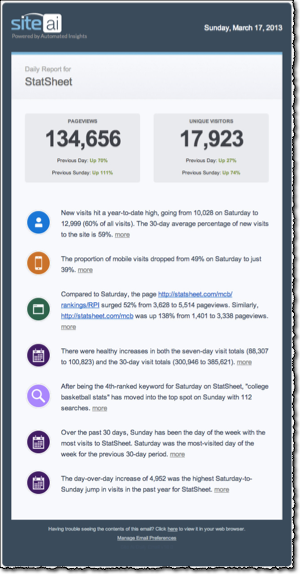
The Next Generation of Data Analysis

In the near future you will use voice commands to ask for actionable stories to be related to you from raw data. It sounds like Star Trek but it’s months away, not years.

Today is the start of IBM’s SmarterCommerce Global Summit 2013. As part of the program IBM invited several industry influencers to attend the event. Last night, I spent some time chatting with Sandra Zoratti, author of Precision Marketing, Stratigent‘s Bill Bruno and Triberr‘s Dino Dogan.

I shared with them how I was first exposed to real data driven marketing online in the early 1990s. I was managing banner ad placement ads on sites like Yahoo!, Excite and AltaVista for a consumer focused software company.  We could measure by each ad creative and placement how much usage and revenue they generated from their software download. From the start we developed hooks into the software to marry up the acquisition data. We could then ask the analysts to run queries for us and send us Excel spreadsheets. We used them to decide where to keep investing in banner ads.

So, of course, when Jeffrey and I started focusing more of our time on online businesses we expected people to do similar things.  Where we ever surprised!

Excel became the de-facto tool for analysts. Do you remember the days of running web logs files in excel to analyze them? This was before tools like WebTrends log analyzer became popular and of course well before any of the javascript based web analytics tools even launched. Excel is still a great tool for analysts as Chief Evangelist for Bing Ads, John Gagnon has shown in his last couple of columns. It is not however, the best tool to share data  and collaborate with the entire organization. How many times have you seen Excel spreadsheets and charts go straight from the inbox to some digital black hole, never to be used again?

This past week, we saw data visualization platform Tableau, enjoy a  successful IPO. I love what you can do with their platform, but  it still doesn’t pack the punch it needs to in order to get an organization to act on the data. As Robbie Allen, the CEO of Automated Insights points out ”most visualizations require the user go through the mental exercise of interpreting the results.”

Social Business is the Collaborative Economy

Here’s a post by my friend Jeremiah Owyang about social business.

When I first saw the tweet about it. I asked “how can you be social without collaboration?”… I had my usual problem with the terms we invent. However, Jeremiah is a real though leader, he defines the trends he sees and I admire how he takes the risk of naming these things.

Social business IS business. Collaboration IS the essence of life. (We make connection and we share stories). Looking past the semantics, I read the article and the chart at the end of his post. He’s got the trend right.

What’s next?

social business

Above Image: Market Opportunities for the Collaborative Economy by Vertical, from Sharable Magazine

Social Business is the Collaborative Economy

What’s the next phase of Social Business?  That’s the question I’m frequently asked.  Without a doubt, the next phase is the Collaborative Economy.

What’s that?  That’s where ands will rent, lend, provide subscriptions to products and services to customers, or even further, allow customers to lend, trade, or gift anded products or services to each other.  This unstoppable trend is fueled by the social web, the specific features include relationships, online profiles, reputations, expressed needs and offerings and ecommerce. Customers are already starting to conduct these behaviors among themselves using TaskRabbit, AirBnb, Lyft, and many others tools –some of these are disruptions and opportunities to ands.

[The next phase of Social Business is the Collaborative Economy; Brands will enable customers to share, trade, lend, gift products and goods using social technologies]

While this movement will have oader global and economic impacts, at Altimeter, we’re focused on disruptions to corporations.  We’re knee deep in interviews for our next report on the Collaborative Economy, and have interviewed startups, VCs, ands, social business software vendors, authors, thought leaders, and are dissecting data of 200 sharing startups, for a oad overview of what it means to business.

Matrix: Phases of Social Business

Caveat: There are many oader impacts inside of the company that also impact HR, recruiting, supply chain, IT, and more, the above is just a sample of the most well discussed impacts.Brands Already On Board: Toyota, Barclays Card, Avis, BMW, WalmartWhat are examples of companies that are already taking advantage of this new social business trend now?  Here’s a few from the Master List of Brands Participating in the Collaborative Economy:  To stay current with car sharing or lending services like Lyft, RelayRide, Zipcar, Uber and more Toyota, OnStar and BMW are allowing cars to be rented.   Barclays Card sponsored and supported bicycle sharing in the city of London, associating their and with the movement.  And retail giant Walmart is considering allowing customers to deliver goods to each other, to compete with Taskrabbit and Amazon.

[The first phase of Social Business impacted anding and PR, it shifted to support and product development.The next phase impacts core business model]

Mindset Change Required in CorporationsSo there you have it, the next phase of Social Business goes beyond marketing and customer support, it changes the fundamental business models and relationships that we will have with our customers. The big change that ands will struggle with, as is it means that ands will have to care about the relationship between customers as they trade and rent your products between themselves.

Twitter Faster Than An Earthquake?

This video is a dramatization of the speed of Twitter.

But in real life, social media is not spreading news in real time.

Whether it’s an earthquake, weather, new product or angry customers causing your next crisis, you won’t have time to plan on a profitable social media strategy.

Today, like it or not, we need to be ready to react in real time.

“Likeonomics” and Other Trends for 2011

The world is coming to us all in real time now.. We still value great content, a thoughtful post, an entertaining video or a quiet conversation with friends.. but we get so much none stop 24/7 content, the value of curating and quick help is accelerating

This is one of the 15 trends. Watch the slide show here for more:

Google Add Their LIKE Button.. the +1

Likeonomics is the trend to watch. People want to share, and they want to do it quickly.

Google moves towards instant mini-recommendations with the +1 button

Are you letting your readers and customers share easily?

And please click the LIKE button

http://www.blogdash.com/publication/blog_claim/blog_claim.png?s=57810765aae5364cd9b63460f589c580

The Future of Media is Here

Chris Brogan created a new media post about the future of media using video, text, and social media connections to get a story started and expanded with conversation.

From a tweet, I read the blog, decided to comment, hope to add some thoughts and continue that conversation.

Chris Brogan on the future of media

With the tools we currently call social media we can have micro conversations, two way exchanges and even media independent connections. I can see a person on Facebook, give them a shout on Twitter and pick up the phone if I miss them on a Skype chat. The meaning has gone beyond the channels used.

One sign that this is evolving is forgetting which medium we used. I bumped into a joint venture partner at an event last week, while there, we had a meal together and exchanged several SMS messages. I checked in using Foursquare and told a mutual friend about it on Facebook. When I later sat down to email him, I had to think of which medium we talk on (it was LinkedIn last week Smile)

Sounds like a bit of hassle. It can be frustrating, but profitable.

Using the connections and tools our partners, prospects and customers prefer get the best response. In the future, we’ll have better tools to sort it out. However, I think the real breakthrough has occurred. We can do it now.

Reply with your comments here. Or tweet me that you comment on the Facebook version of Chris’s post. Make a Youtube response if you wish.

Regardless of the media or channel… get into the conversations. (maybe not this conversation about conversations.. but there are many that will be profitable).

People are talking. It’s here if you listen.

Listen and love (respond as you would to a friend).. it’s as simple as that.

Are You Operating in Real Time?

As we work on Profitable Social Media the book, we’ve learned a few things about creating content in real time. In an editorial meeting, we’ll have more social media news to talk about than we have edits to remove.

Since we don’t want to release a 800 page book, we’ve got some quick decisions to make to get the best possible book for our readers.

Twitter Chats

Get a big dose of learning about the power of real time communications and marketing, join us for a Twitter Chat.

Any Twitter user can join with any client app, or even the a Twitter Search.

You’ll have more fun if you create a column of just the #SMmanners tweets so you can see all we are talking about

Join me on the #SMmanners chat at Feb 1 at 7 pm PST

During a meeting today, I saw a tweet about tonight’s #SMmanners chat on Twitter. which got me thinking about real time. (the only way I’ll get a blog post about it up before I guest there tonight Smile)

Chat’s are going on all the time. People are posting about their problems, looking for solutions, looking for you.

By setting up an alert,  you can have a notice sent to  you when a keyword or phrases used anywhere on the Internet.

Do you have time to listen to your customers and prospects?

Just listen and love .. It’s as simple as that