What Is Your Visual Web Presence? [infographic]

They say a picture is worth 1000 words. If that’s so, one photo is longer in words than most blog post. Do you have a visual web presence?

The following infographic depicts just how visual the weather has become. With faster computers, higher bandwidth, and more and more to see every day, it’s a good time to think about your visual web presence.

What’s is your Visual Web Presence?

Discussing Visual Web Presence

I purposely left most of the discussion that I’d normally put in text out of this info graphic based post.

Did I go too far?

Maybe. I think there’s still plenty of room for discussion. Some of that of course can happen and audio, and a lot of it is much more convenient to happen in text.

Add your comments below let’s have a good old-fashioned text discussion/chat?

The @LadyGaga Performance is Best Understood by Her Most Loyal Social Media Fans

ladygaga

I’m reading “Monster Fans” by Jackie Huba and learning about the blue balls that @LadyGaga used on TV and how it’s part of her social media success:

“What the heck are these blue balls in Lady Gaga’s MTV Music Video Awards performance Sunday night?”

That’s the question I got emailed this week from a friend of mine. Since I wrote a book about how Lady Gaga built her loyal fan base, he thought I would know. Well, this confusion from my friend is a classic Gaga technique for building loyalty and is one of the lessons in my book.

The idea here is to create and use symbols that only your community of loyalists will understand.

In history, studies of cultures and societies often show an emergence of shared symbols. We can all visualize many symbols we share with others as members of a given group, city, or country. These shared symbols are tangible vehicles through which some meaning is expressed. The symbols could be gestural, pictorial, object-oriented, linguistic, or some combination of these. Through the repeated process of rituals, symbols are given significance in the group. Shared symbols also have the ability to be exclusionary. Those who can recognize and understand the meaning of these symbols feel part of the group, like they be long, while outsiders will not understand the meaning and turn away, sometimes mocking the symbols. Gaga and the Little Monsters use many symbols to communicate with each other, with the most well known one being the “monster paw.” By using these symbols that only her loyal fans understand, she is speaking to them in a special language. Fans feel a strong bond to the community, and to Gaga, because they feel part of a special club of people who understand what the symbolism represents, while outsiders do not.

This is exactly what Gaga was doing with the VMA performance of her new single, “Applause,” from her upcoming album ARTPOP. The concept of the album is that Gaga wants to bringing art back into pop culture. The 4:51 minute performance was chock full of costume changes (three in all), blue metallic balls and face painting.

You may not have understood all the imagery or references, but Gaga doesn’t care. She want to create an entertaing performance for everyone but she includes these special symbols that she knows only her diehard fans will understand. Here’s what most Little Monsters recognized

Special metallic blue balls the size of cantaloupes are carried by dancers at one point in the performance and even Gaga grabs one  and throws it across the stage. The balls are a reference to pop artist Jeff Koons “Gazing Balls” exhibition from earlier this year. Gaga is a big fan of the artist and he is mentioned in the lyrics to “Applause.”

Erik Stafford and Carlos Fernandes: Inside Agency Success

Erik Stafford and Carlos Fernandes: Inside Agency Success

Erik Stafford

Erik Stafford

Erik Stafford is the owner of Stafford Marketing and you’ve probably seen his work in mainstream magazines and newspapers, in the print and television campaigns of large corporations, on successful entrepreneurs’ websites, and in the work of hundreds of marketers who’ve used my design and copy tactics to boost their own sales.

He comes from an advertising and design background and have won numerous awards over the past fifteen years, including several AAF-ADDY Awards. He has worked with a wide range of companies around the globe as Creative Director at ISOOSI Innovative Marketing Studio.

Carlos Fernandes

Carlos Fernandes

Carlos Fernandes is the Founder and CEO of ISOOSI. He believes firmly that their success is pinned on the success of their clients and with that work ethic has molded the company into an academy of excellence and a haven for creative thinking.

He has successfully built several businesses (from concept through to sale) and his entrepreneurial talent and creative flare have led him to be acknowledged in the UK, the Caribbean and North America as an inspired and resourceful business leader.

New Marketing Podcasts with Warren Whitlock on BlogTalkRadio


How to Unleash the Power of Crowds – Think and Grow Rich

How to Unleash the Power of Crowds – Think and Grow Rich

Most have attained their greatest success just one step beyond their greatest failure.” -Napoleon Hill

Imagine bringing the wisdom and lessons of Think and Grow Rich to a new generation, adapting it so that today’s population, growing up in a different world, can learn about this in a inspiring way… social, mobile, and viral!

declandunnOur guest is Declan Dunn, pioneer in internet marketing and new media, an expert on customer relations, conversions, retention and ROI.

  • How TAGR planned and pre launched the Facebook page, while building the web site and mobile app;
  • How to target influencers engaging, spreading the word and to creating a better product;
  • Why new media – doing several short movies, with interactive participation of the audience, and a mobile app – are critical parts of moving the story beyond just words in the book, and into action.

Plus the power of crowd funding and IndieGoGo to build an audience.


Current Entrepreneur Podcasts at Blog Talk Radio with Warren Whitlock on BlogTalkRadio


The Next Generation of Data Analysis

In the near future you will use voice commands to ask for actionable stories to be related to you from raw data. It sounds like Star Trek but it’s months away, not years.

Today is the start of IBM’s SmarterCommerce Global Summit 2013. As part of the program IBM invited several industry influencers to attend the event. Last night, I spent some time chatting with Sandra Zoratti, author of Precision Marketing, Stratigent‘s Bill Bruno and Triberr‘s Dino Dogan.

I shared with them how I was first exposed to real data driven marketing online in the early 1990s. I was managing banner ad placement ads on sites like Yahoo!, Excite and AltaVista for a consumer focused software company.  We could measure by each ad creative and placement how much usage and revenue they generated from their software download. From the start we developed hooks into the software to marry up the acquisition data. We could then ask the analysts to run queries for us and send us Excel spreadsheets. We used them to decide where to keep investing in banner ads.

So, of course, when Jeffrey and I started focusing more of our time on online businesses we expected people to do similar things.  Where we ever surprised!

Excel became the de-facto tool for analysts. Do you remember the days of running web logs files in excel to analyze them? This was before tools like WebTrends log analyzer became popular and of course well before any of the javascript based web analytics tools even launched. Excel is still a great tool for analysts as Chief Evangelist for Bing Ads, John Gagnon has shown in his last couple of columns. It is not however, the best tool to share data  and collaborate with the entire organization. How many times have you seen Excel spreadsheets and charts go straight from the inbox to some digital black hole, never to be used again?

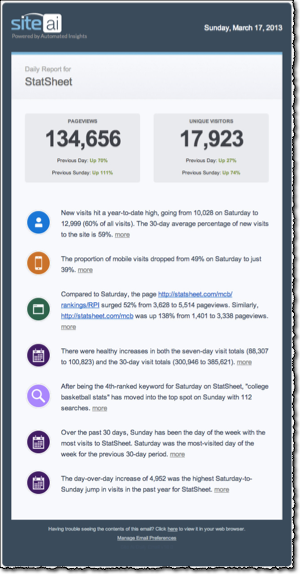
This past week, we saw data visualization platform Tableau, enjoy a  successful IPO. I love what you can do with their platform, but  it still doesn’t pack the punch it needs to in order to get an organization to act on the data. As Robbie Allen, the CEO of Automated Insights points out ”most visualizations require the user go through the mental exercise of interpreting the results.”

5 As of Social Media Measurement

There are literally gigabytes of people fighting about the ROI of social media. The truth is, there are certainly outcomes that we should all be measuring to ensure that we are using social media measurement in the most effective way possible.

I think of social media measurement as a continuum of measures. Consider using one or more of these in your measurement strategy.

Activity: This measure is all about what YOU do. Do track your activities and benchmark them against results but don’t stop there. Many agencies tend to focus their reports on activities they completed for a client, but they should not be considered results measurement.

Attention. This measure is all about reach or “opportunities to see.” They say that any publicity is good publicity, but as we all know in this 24/7 news-hungry world not ALL attention is good attention. The easiest thing to measure in social media is attention. You can see how many visits your page has, how many were unique and how many were repeat or new visitors. Attention looks at volume, number of friends and reach.

Awareness. This measure is all about engagement with you. It means that people are starting to become aware that you exist in social channels. It doesn’t mean they will take any action beyond this, or that there will be any appreciable business results.  Awareness measures include Likes, mentions, share of voice, referrals and % of followers engaged.

Attitudes. This measure is all about conversation about you. You can measure online sentiment to get a crude idea of where you stand with the community over time, mostly positive, mostly negative and mostly neutral. However, sentiment doesn’t give a full view and can be significantly skewed if you use automated sentiment tools. You can look also at customer satisfaction surveys and cross tab with their involvement with social media sources, loyalty over time, and repeat visits to get an idea of attitudes. The gold standard is conducting a relationships survey.